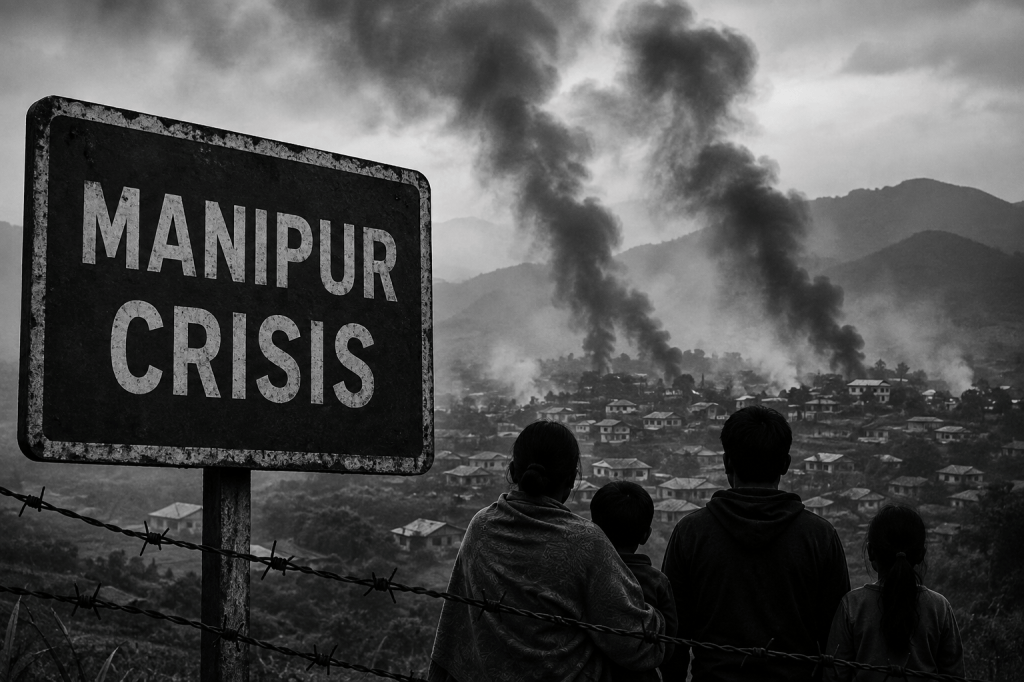
September 2026 began with renewed escalations in Manipur’s three year long civil strife. Several houses belonging to members of the Naga tribe were set ablaze in the Kangpokpi district, following the killing of three Kuki’s in what were described as ‘militant attacks’.
Manipur is a state in the northeast sharing a 400 kilometre long international border with Myanmar. Geographically, the state has been historically divided into the Imphal valley, which constitutes about 10% of the total area and the surrounding hills which constitute the remaining territory. The valley, home to the state capital Imphal, has traditionally been inhabited by the Meitis who are majorly Hindu and constitute around 57% of the state’s population. The surrounding hill regions, on the other hand, are predominantly inhabited by 34 tribal groups broadly categorised as Nagas and Kukis, and practise Christianity. The Nagas tribes are concentrated in the Northern hill districts while the Kuki tribes primarily inhabit the districts in the South.
The tribal communities have been accorded Scheduled Tribe status which provides them with special provisions in government jobs, education and land rights. The Manipur legislative assembly comprises of 60 seats out of which 40 are held by the valley areas and 20 by the hill districts.
Manipur holds strategic importance for the Indian security establishment as it sits on the edge of the “Golden Triangle”, an area in Southeast Asia, located at the tri-junction of Myanmar, Laos and Thailand. It is considered one of the world ‘s most notorious hubs for illicit drug production and trafficking.
The violence that erupted on May 3rd 2023 can be traced back to an order of the Manipur high court, passed in April 2023. The ‘affirmative action’ order passed by the Court, recommended to the state government to consider the long-standing demand of the Meiti community for Scheduled Tribe status.
The prospect of the Meitis being granted ST status triggered apprehensions amongst the tribal groups who feared dilution of their access to job and educational opportunities. On May 3rd 2023, the tribal communities organised protest rallies against the Meiti demand for ST status, while counter-rallies were held by Meitis groups. The demonstrations soon spiralled into violence, leading to clashes between the two communities and marking the beginning of the prolonged ethnic conflict in the state.
Though the High Court’s order was the immediate trigger, the roots of the crisis ran much deeper. The tribal communities of Manipur have long expressed their discontent with the policies of the state government for being discriminatory and prejudicial towards them. They have particularly criticised the government of former Chief Minister N Biren Singh for allegedly portraying the hill residing tribes as “poppy cultivators”, “forest encroachers”, “drug smugglers” and “illegal immigrants”.
The 2021 civil war in neighbouring Myanmar further aggravated the grievances of Manipur’s tribal population. The conflict triggered a significant influx of Chin refugees into Manipur and Mizoram. The Chins share close ethnic and cultural ties with the Kuki community in Manipur. The refugee influx was subsequently instrumentalised in the state’s ethnic tensions, with sections of the political establishment and Meitei groups conflating the Chin refugees with the Kukis and portraying the latter as “illegal immigrants”. This further deepened existing mistrust between the valley-based Meiteis and the hill-dwelling tribal communities.
The police and political machinery have struggled to contain the violence and restore law and order in the State. Adding to the authorities’ challenges, the protestors looted State police armouries, with an estimated 6,000 firearms and 600,000 rounds of ammunition reportedly stolen.
Facing unhinged criticism and backlash over the handling of the issue, CM Biren Singh resigned in February 2025 after 20 months of intermittent violence. President’s rule was imposed and the union government took charge of the situation. The violence largely subsided with sporadic bouts of unrest. But no meaningful progress towards peace could be made.
After nearly a year of political uncertainty, Manipur government was reinstated with a new CM in February 2026. Since then, the government has made several attempts to build confidence between the communities, initiate negotiations, re-open trade routes and roads and restore law and order. However with more than 60,000 people displaced, 258 lives lost and over 10,500 residential structures destroyed or damaged, the stakes for restoring lasting peace remain exceptionally high. The road to peace may be long, but rebuilding these bonds remains essential to Manipur’s future.


Leave a Reply