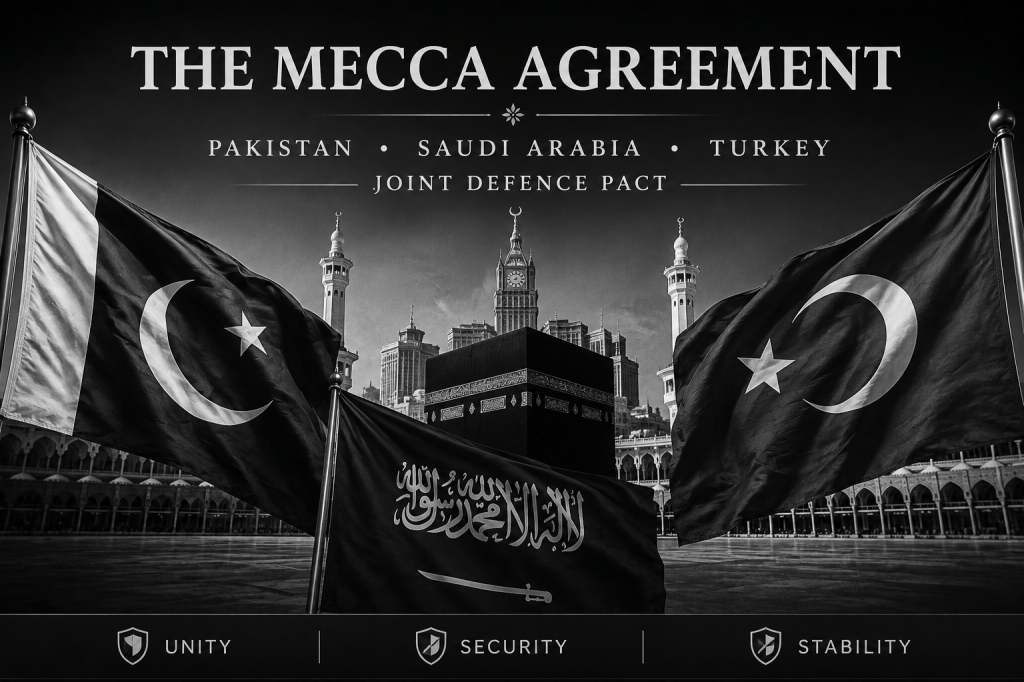
The headlines for the past week have been dominated by the Mecca Joint Defence Agreement. It is a defence pact signed on 7th August 2026 between Pakistan, Saudi Arabia and Turkey. The pact has widespread ramifications for the world at large, especially the Middle East and West Asia region, which is marred by regional as well as geopolitical conflicts. The policy corridors in India have maintained official silence regarding the agreement but silence does not imply ignorance. Defence analysts and strategic experts are watching the developments closely due to the presence of its all-weather foe, Pakistan and a hostile contemporary, Turkey.
The pact is seen to be building upon the earlier signed Strategic Mutual Defence Agreement of September 2025, between Pakistan and Saudi Arabia, effectively converting the bilateral arrangement into a trilateral security pact. The joint statement was issued in Mecca, the holiest site in Islam, which lends its name to the title of the agreement. The statement says “any armed attack against any one of the three states shall be regarded as an attack against them all”. It is similar to NATO’s Article 5 which commits members to collective defence in the event of an attack on any one member.
The three signatory countries share concerns about the increasingly aggressive military stances of Israel and Iran and the inability of the US to contain the regional upheaval. Iran is a Shi’ite nation as opposed to Pakistan and Saudi, which are both Sunni majority nations. For Saudi, three years of conflict between Israel and Hamas has upended oil prices and development within the region. It is further concerned by the Houthi attacks on Yemen, which shares borders with Saudi. Furthermore, Turkey views Israels’ expanding presence in Gaza and Syria, its southern neighbours, as a threat.
The three countries possess varying capabilities and strengths which make them each an important contributor to the pact. Turkey, a NATO member has its second largest military and advanced defence capabilities including drones and a growing aerospace sector. Saudi is home to Islam’s holiest cities and one of the world’s top oil exporters. It is strategically located within the gulf and shares relations with big and middle powers like USA, India and China. Pakistan is the only Muslim country armed with nuclear weapons and long-standing relations with Saudi, China and USA.
The statement has been the topic of discussion in Indian policy circles for security and diplomatic reasons. Turkey, in the past, has not minced words in its criticisms against India. In May 2025, during the India-Pakistan conflict (Operation Sindoor), Turkey openly came out in support of Pakistan and even provided the latter with drones which were used against India during the skirmish in large numbers. Furthermore, the Turkish defence industry will act as a year-round supplier of defence materials, equipment and superior technology to Pakistan, potentially affecting India’s conventional military advantage.
The strengthening of Pakistan’s ties and alliances can hamper India’s efforts at building international consensus against cross-border terrorism. It also poses the risk of Pakistan gaining leverage in the Kashmir issue. The mutual defence clause also leads to questions of whether Turkey and Saudi will get drawn into any future India-Pakistan conflict or hostilities. The presence of Saudi is a point of solace for India due to the long-standing relations between the two countries. Their areas of interest overlap in defence, oil, trade, energy, investment and technology sectors. A strengthening Pakistan-Saudi relation does not automatically imply a weaker India-Saudi bond.
What has also left people scratching their heads is the presence of Turkey in NATO. Being a NATO member, it is bound by the terms of Article 5. The problem arises if a conflict emerges between either Pakistan or Saudi and a NATO member. Which side will Turkey pick in such a situation?
The agreement is in its nascent stages and its actual mechanisms remain to be seen. The pact warrants close observation, rather than immediate alarm. India should not let this pact affect its standing ties with Saudi and should in fact work on strengthening its relations with its Western frontier countries. India can also work towards improved relations with Turkey, without compromising on its core values, especially regarding Kashmir. Only time will tell whether the agreement evolves into a tangible strategic challenge for India and the wider region, or proves to be merely a spark that gradually fizzles out.


Leave a Reply