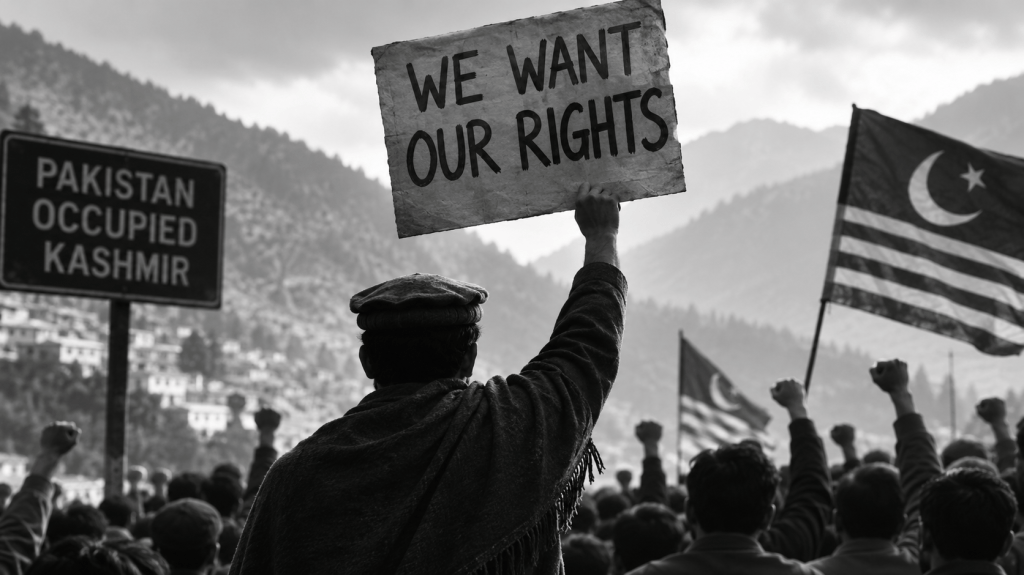
Over the past 2 months, Pakistan occupied Kashmir has been witnessing mass protests and uprisings against the government in Islamabad. The protests were timed with the three-phase election to the 53 member Pakistan legislative assembly. The government has responded in a high handed manner, leading to the death of 40 civilians and many more injuries. Though the immediate trigger was the 12 reserved seats in the assembly for refugees from Jammu and Kashmir, the issues have been simmering since 2023 when the first wave of protests began.
In 1947 when Pakistani insurgents attacked Jammu and Kashmir in a quest to occupy the territory for itself, the Indian army intervened and a struggle for the ‘crown jewel of India’ ensued. It ended in a UN brokered ceasefire and status quo, whereby a part of the territory came under Pakistani control in what came to be known as ‘Pakistan occupied Kashmir’. Unlike its Indian counterpart where regional parties have dominated the scene, PoK has witnessed the rule and dominance of whichever party has occupied the national stage at the time.
Out of the 53 seats in the PoK legislative assembly, 12 are reserved for refugees who migrated from J&K in 1947 and 8 for women (5), Ulamas (1), foreign Kashmiri resident (1) and technocrats (1). This leaves 38% of the seats out of the ambit of the voters to the assembly. These seats are filled by the loyalists of the party ruling at the centre, who neither reside in the region nor are familiar with its troubles and concerns. The polling for the seats is conducted outside PoK and the local Election commission has no role to play. Critics argue that the seats go to whichever party is in power at the Centre and allows Islamabad to further its political agenda in the Assembly. Furthermore, the salaries and expenses of the 12 members are paid out of the budget of PoK, without them contributing to the tax pool of the region.
In addition to the above mentioned issues, the citizens have also been grappling with high electricity charges and shortages of wheat. The Mangla dam which is built on the rivers of PoK, generates hydropower for the National grid of Pakistan, which is then ‘exported’ back to PoK. Thus the residents in the region pay a higher market rate for electricity compared to the residents in the mainland territory, who are provided electricity at subsidised rates. The residents of PoK have also expressed their grievances regarding chronic underdevelopment, heavy security deployment, rigged and unfair elections and general mismanagement of the region.
The current protests are being spearheaded by the Jammu Kashmir Joint Awami Action Committee (JAAC), an umbrella organisation comprising traders, lawyers, students and other civil society groups. There have been repeated clashes between JAAC and the security forces, Internet suspensions, detentions and arrests under the stringent seditionary laws. The JAAC has called for abolition of the 12 reserved seats as its main demand. Its other demands are listed in a 38-point memorandum which are centered around bread and butter issues, better infrastructure and parity in treatment with the four official provinces of Pakistan.
Supporters of the reservation draw comparison with India which also has reserved seats in the Jammu and Kashmir assembly for people displaced from Pakistan occupied territories but a crucial difference exists- India keeps those seats vacant, unlike Pakistan.
Pakistan has been wrongly calling out India for flaming the protests and instigating the PoK residents. Instead of looking inward it is choosing to deflect the blame towards its neighbour and disregarding the genuine concerns of the protesters. India has dismissed the charges and has condemned the use of “ruthless force”.
The ‘Supreme Court of Azad Jammu and Kashmir’ has sided with the government and upheld the validity of the 12 reserved seats, holding that the seats are protected under the Azad J&K Constitution and cannot be altered through “administrative measures, political agreements or public pressure”. An amendment to the constitution will require a 2/3rdvote of the total membership as well as a prior approval of the Government of Pakistan.
Pakistan was created on the premise of a ‘two-nation theory’ which sought to forge a homogeneous and united Muslim identity. It left little room for the country’s diverse ethnic, linguistic, cultural or regional identities, which were labelled as ‘parochial tendencies’. Over the decades, these tensions have resurfaced repeatedly, not only in Pok but also in regions such as Gilgit Baltistan and Baluchistan. Relying on brute force and coercion risks deepening public resentment and mis-trust. The federal government must engage constructively with the JAAC and address their legitimate demands. Failure to do so could transform the regional protests into a wider crisis of governance and security.


Leave a Reply