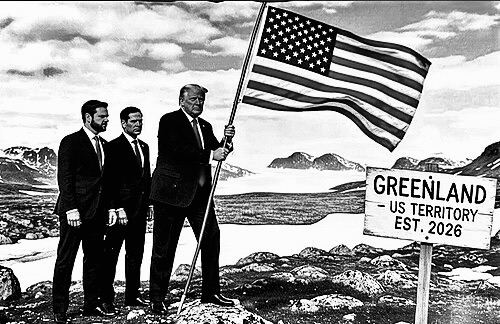
When we think of Greenland, we visualise an island decked in snow, colourful houses splashed across its territory like paint on a canvas and an Arctic climate, on account of its massive ice sheet and location. The winters are long, severe and chilly- just like the rift between USA and Denmark, that has played out over the past two years, coinciding with Donald Trump’s second stint at the White House.
Greenland, the world’s largest island, is an autonomous territory of the Kingdom of Denmark. It is sparsely inhabited, with a population of about 57,000 people. Located between the Arctic and Atlantic oceans, its economy is primarily based on fishing, followed by a large public sector which employs around 40% of the local workforce. Greenland receives substantial financial aid from Denmark in the form of subsidies, which contribute significantly to the public revenue of the island. While Greenland manages most domestic affairs, Denmark continues to oversee foreign policy, defence and monetary matters.
For decades, Greenland was seen as a distant, frozen landmass, far removed from conventional political and economic conversations across the globe. But the perception has been rapidly changing. Greenland’s arctic location has made it a critical gateway between North America and Europe making it ideal for monitoring air and naval movements across the North Atlantic. Furthermore, global warming has accelerated the melting of Arctic ice, opening previously inaccessible maritime routes and increasing access to the region’s vast potential resource base—including oil, natural gas, critical minerals and fisheries—much of which has long remained concealed beneath the ice.
The island rose into global prominence in 2025 when Donald Trump made an offer to “buy the island”, followed by a similar offer in his first term of Presidency. In March 2025, US Vice President JD Vance visited Greenland and accused Denmark of failing to invest enough to ‘protect the island territory’.
The back and forth between the two nations continued throughout the year, with Denmark firmly asserting that the island was not for sale. Divisions emerged within NATO- a Cold-war era military alliance to which both countries belong, as Denmark received support from several European members.
The January 2026 capture and transfer of the Venezuelan President Nicolas Maduro and his wife to New York to face criminal charges was widely viewed as a blatant violation of Venezuela’s sovereignty. The episode further heightened concerns among European nations about the protection of their own sovereignty and territorial autonomy.
Trump publicly refused to rule out military or economic force to acquire the island and triggered a diplomatic crisis, forcing both countries into months of intensive negotiations. Trump threatened 10% trade tariffs (which could be increased to 25%) “on any and all goods” sent to the US from Denmark, Norway, Sweden, France, Germany, the UK, Netherlands and Finland if those countries did not support his plans. In a post on the site Truth Social, he wrote “NATO has been telling Denmark, for 20 years that ‘you have to get the Russian threat away from Greenland.’ Unfortunately, Denmark has been unable to do anything about it. Now it is time and it will be done!!!”
Unbecoming for the President of the world’s largest economy, in a text message to Norway’s Prime Minister, Trump also said that he “no longer felt obliged” to focus on peace after not being awarded the 2025 Nobel Peace Prize.
By January 2026, things seemed to settle down when, on the sidelines of the World Economic Forum, Trump and NATO Chief Mark Rutt held what they called a “very productive meeting” wherein Trump withdrew the tariff threat.
Fast forward to September 2026, the leaders of US, Greenland and Denmark have signed an agreement during their visit to the United Nations General Assembly.
Though the agreement stops short of a complete annexation of Greenland, it does grant significant concessions and powers to the USA in the form of a larger US military presence on the island through expansion of its already operational Pituffik Space Base and construction of two new defence sites.
The agreement provides for the establishment of a “Golden Dome” defence system in Greenland as a shield against ballistic missile threats. US aircraft and vessels have been granted broad access across Greenland and its territorial waters. Non-NATO states as well as US adversaries will not be permitted to establish new military installations on the island or make sensitive investments without express written approval from USA.
Danish prime minister Frederiksen has described the agreement as a “deal that can last forever” and said that it underlines the importance of NATO alliance, while at the same time respecting Greenland’s right to self-determination.
The deal addresses Trumps’ concerns over potential Chinese and Russian incursions into the island by granting the US significant say over the island’s potential use as a hub for military bases. It also gives Washington greater leverage over extraction of natural resources that have become increasingly critical to modern manufacturing. What remains largely unaddressed is the deal’s potential impact on climate, the local ecology, the indigenous Inuit people- which constitute roughly 85-88% of the population, the fisheries sector and Denmark’s relation with other countries. In an era of growing multilateralism, the pursuit of strategic power and critical resources cannot come at the expense of another society’s environment, livelihoods, and autonomy.


Leave a Reply